
How Pickleball ELO Ratings Work
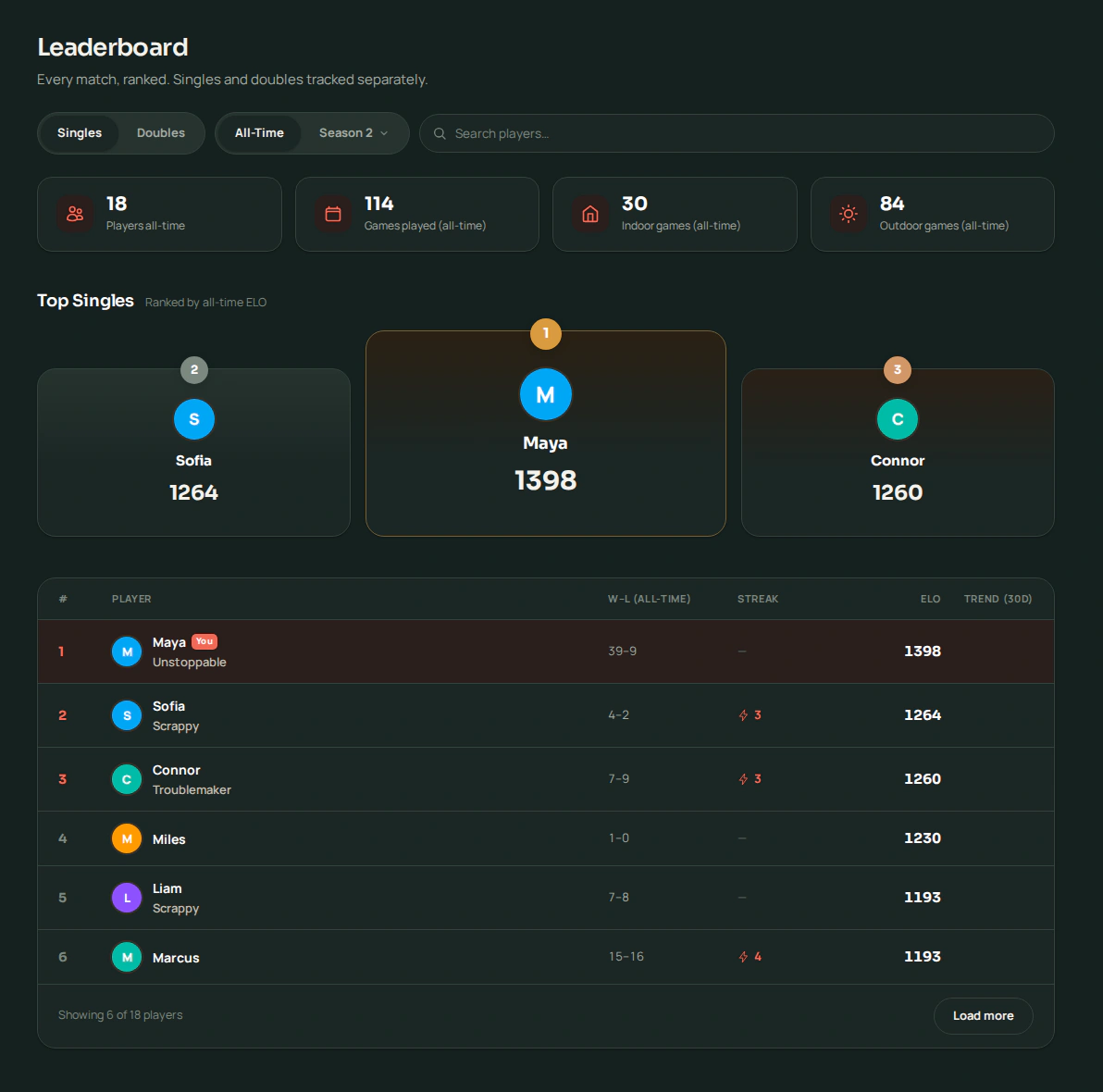
An ELO rating is a single number that estimates how strong a player is, based on who they have beaten and who has beaten them. It was designed for chess in the 1960s by Arpad Elo, and it works for any sport where two sides play and one of them wins.
The idea it is built on is small: beating someone stronger than you is more informative than beating someone weaker. A rating system that ignores that is just counting wins.
What the number actually means
An ELO rating has no units. It is not a percentage, and it does not measure anything on its own. It only means something relative to other ratings in the same pool.
What it encodes is a prediction. The gap between two ratings translates directly into the expected result of a match between them:
- Equal ratings mean a coin flip, an expected score of 50%.
- A gap of about 100 points means the stronger player is expected to win roughly 64% of the time.
- A gap of about 200 points means roughly 76%.
- A gap of about 400 points means roughly 91%.
Read that backwards and it tells you what a rating is for. Two players 30 points apart should have a close, genuinely competitive game. Two players 400 points apart should not be on opposite sides of the same net if anyone wants an interesting evening.
That is the practical value of a rating in a recreational group, and it is worth being clear that it is a matchmaking tool before it is a ranking.
How the number moves
After a match, both ratings update. The winner gains what the loser drops, so the total in the pool stays constant. Nothing is created; it moves between players.
The size of the move depends on how surprising the result was. The system had an expectation, the match produced a result, and the rating shifts in proportion to the difference between them.
- Beat someone well above you. The system expected you to lose, so the correction is large. Your rating jumps.
- Beat someone well below you. The system already expected this, so almost nothing happens. You gain a point or two.
- Lose to someone well below you. Expected to win and did not, so the correction is large in the other direction.
- Lose to someone well above you. Barely costs you anything. The system expected it.
This asymmetry is the part people find frustrating, and it is doing the most important job in the system: it makes a rating impossible to farm. You cannot climb by only playing people you can beat, because those wins are worth nearly nothing. The only way up is to beat people who are not supposed to lose to you.
Why new players move faster
Most implementations move newer players’ ratings in larger steps and settle them down as games accumulate. In chess this is the K-factor; the principle is the same wherever it is used.
The reason is confidence. When someone has played three games, the system has almost no information about them, and their number is closer to a guess than an estimate. Large steps let it correct that guess quickly. Once someone has played fifty games, the rating reflects real evidence, and it should not swing wildly on one bad night.
The practical consequence: a rating needs somewhere in the range of ten to twenty games against varied opponents before it is worth arguing about. Variety matters as much as volume, because the system places you by comparing you against people it has already placed. Ten games against the same partner teaches it very little.
Always read a rating next to a game count. A rating without one is half a number.
Singles and doubles are not the same skill
This is where a lot of recreational implementations go wrong. Doubles is not singles with a partner. Court coverage, communication, stacking, poaching and the ability to hold your position at the kitchen line are doubles skills, and plenty of excellent doubles players are unremarkable in singles. The reverse is just as common.
Blend both into one number and you get a figure that describes nobody accurately. The fix is simply to keep two ratings per player, one for each format, and update them independently.
There is a second question underneath it: in doubles, is the rating attached to the team or to the individual? Team-based ratings capture chemistry, which is real, since some pairs are genuinely better together than their individual numbers suggest. Individual ratings are easier to use for matchmaking, because you can pair anyone with anyone. Neither is wrong. Volii starts a new doubles team from the average of its two players’ singles ratings and moves it as a team from there, and lets admins switch to ranking individuals instead.
ELO, DUPR and the 2.0 to 5.0 scale
Pickleball has several rating systems and they answer different questions. It is worth knowing which one you are looking at.
The 2.0 to 5.0 skill scale is a description of ability, usually self-assessed or assigned by a coach, expressed in half-point bands. A 3.5 can reliably do things a 3.0 cannot. It is useful for signing up to the right session at a rec centre, and it is coarse and slow to change by design.
DUPR is a global rating that pools results across clubs and tournaments, so a number means roughly the same thing wherever you go. That portability is the point, and it depends on results being submitted into the shared system.
A club ELO is local. It ranks the people in your group against each other, using only games played inside it, and it updates the moment a score is entered. It says nothing about how you would fare against a stranger three cities away, and it is the most useful of the three for deciding who should play whom on Tuesday.
These are complements, not competitors. A club rating for matchmaking within your group and a portable rating for playing outside it answer different questions, and neither replaces the other.
Why leaderboards reset
A rating that accumulates forever slowly stops measuring current form and starts measuring seniority. The people at the top are the ones who have been playing longest, newer members can see they will not catch up for a year, and they disengage.
Resetting the active leaderboard each season fixes that without throwing away history. Current standings answer “who is playing well now.” Career peaks and full match history stay on a profile and answer “how good have you ever been.” Both are worth having, and one leaderboard cannot show both.
What ELO does not tell you
Worth naming, because over-reading a rating is how groups end up resenting one:
- It does not measure improvement in isolation. If everyone in your group improves at the same rate, everyone’s rating stays flat. You are all better; the ordering did not change.
- It does not transfer between pools. A 1500 in your club and a 1500 in another club are not comparable unless people play across both.
- It cannot see anything but results. It does not know you played through an injury, or that the game was 11-9.
- It is not a judgement of a person. This sounds obvious, and forgetting it is the single most common reason a group abandons ratings within a month.
Introduce a rating as a way to make games closer, and it stays fun. Introduce it as a league table, and the bottom half of the table stops coming.
The short version
An ELO rating predicts results rather than counting wins. It moves most when a result was unexpected, which is what makes it unfarmable. It needs ten to twenty varied games to mean much. Singles and doubles deserve separate numbers. It is local to whoever is in your pool, it resets to keep measuring current form, and it is at its best when it is being used to decide who plays whom rather than who is best.
Keep reading
- Win Rate Is Lying to You: Tracking Stats That Actually MatterRaw win percentage doesn't know who you played. Here's why ELO, singles/doubles splits, and season resets tell you more than a win-loss record ever will.
- How to Organize a Recurring Pickleball GroupA practical guide to starting a weekly pickleball group and keeping it running: how many players you need, picking a slot, splitting court costs, keeping games competitive, and what to stop doing in the group chat.
Stay in the loop
Occasional updates on new Volii features. No spam.