
Win Rate Is Lying to You: Tracking Stats That Actually Matter
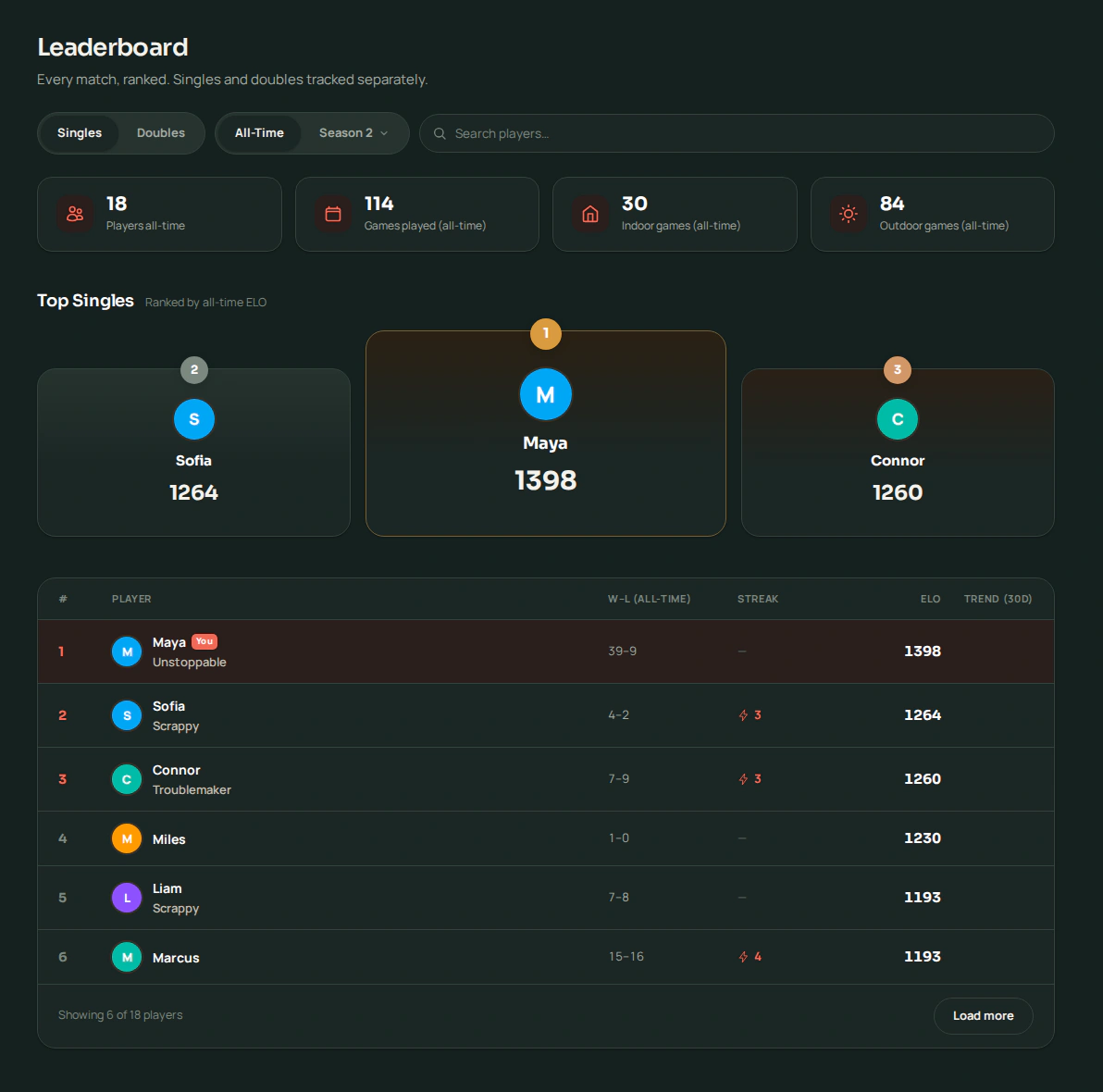
“I’m winning more than I’m losing” feels like proof you’re improving. It isn’t, not on its own. Win rate doesn’t know anything about who was on the other side of the net. A 70% win rate padded out against weaker players tells you less about your game than a 45% win rate against players who are actually challenging you. Raw win-loss is the same stat whether you earned it or backed into it.
What ELO actually fixes
An ELO rating isn’t just “wins minus losses,” it’s wins and losses weighted by who you beat or lost to. Beat a stronger player and your rating jumps more than beating someone weaker would. Lose to a weaker player and it costs you more than losing to someone better. The practical effect: a new player’s rating moves fast at first, since the system doesn’t know where they belong yet, then it levels off once they’ve played enough games to prove where they actually rank. One early loss doesn’t define a season, and one lucky early win doesn’t overstate you either, the number just needs a few games to catch up to the truth.
Singles and doubles aren’t the same skill
Volii tracks Singles ELO and Doubles ELO as two separate ratings per player, not one blended number. By default, a new doubles team starts from the average of its two players’ Singles ratings and moves as a team from there, so a player who’s excellent in doubles but middling in singles doesn’t get flattened into one misleading score. Admins can also switch Doubles ELO to rank individuals instead of teams, and change it back, at any time. If your club only tracked one combined number, you’d be averaging away exactly the information that makes rivalries and matchmaking interesting.
Why the season resets
Every new season resets the active leaderboard to a clean start, while your career-best peak stays on your profile permanently. That’s deliberate, not a limitation. A leaderboard that never resets rewards whoever’s been playing longest, not whoever’s playing best right now, and it gets harder for newer players to see themselves catching up. A fresh season means this month’s form actually shows up in this month’s standings.
How many games before your rating means anything
The honest answer for most rating systems is that the first handful of games are a guess, and the number becomes worth arguing about somewhere in the range of ten to twenty games against varied opponents. Not ten games against the same partner: variety is what actually pins a rating down, because the system learns where you sit by comparing you to people whose positions it already knows.
This has a practical consequence for how you read a leaderboard. A player five games in, sitting near the top, has not proven anything yet, and treating that position as real is how groups end up in arguments about whether the ratings “work.” Look at games played next to the rating, always. A rating without a game count is half a number.
It also means the fastest way to get a useful rating for a new member is to spread their first few sessions across different opponents rather than letting them settle in with one regular partner.
Reading a rating change without taking it personally
Ratings move in both directions, and the moves are not symmetrical. Beating someone well above you is a large gain. Losing to someone well below you is a large loss. Beating someone below you barely registers, which is the part people find annoying and is also the part doing the real work: it is what stops a rating from being farmable by only playing people you can beat.
Two things worth saying out loud to a group when you introduce ratings, because they head off most of the friction:
A drop is not a verdict on your evening. A single loss to a strong player can cost less than a loss to a weak one. The number is measuring who you played, not how you felt about it.
Nobody’s rating is a secret ranking of them as a person. This sounds obvious and is the single most common reason groups abandon ratings in the first month. Frame it as a matchmaking tool, which is what it is genuinely useful for, and it stays fun. Frame it as a league table, and the bottom half stops showing up.
The stats that are not worth tracking
Not every number earns its place, and a group that tries to log everything usually ends up logging nothing.
Point differential across a whole session is mostly noise unless your games are all played to the same target. Individual shot statistics are excellent for a coach and unrealistic for a Tuesday night, because someone has to record them instead of playing. Attendance streaks are fun but reward availability rather than play. Raw games played rewards the retired member with unlimited free time.
The set that survives contact with a real group is small: who played, who won, and against whom. Everything genuinely useful, ratings included, is computed from those three facts, and all three are things people will actually record while catching their breath between games.
The “why,” not just the “what”
Win rate answers “did I win more than I lost.” It doesn’t answer “against who, and does it matter.” A player profile’s Insights cards close that gap: your toughest matchup, your best chemistry partner, the rival who beats you most, and your longest active streak, computed automatically from the same game log instead of something you’d have to reconstruct by scrolling back through match history.
The actual fix
Win rate is a summary. ELO, singles/doubles splits, and season resets are closer to an explanation. If the question you’re actually asking is “am I getting better,” track the stat that’s built to answer it, not the one that just happens to be easiest to count.
Related features
Keep reading
- How Pickleball ELO Ratings WorkWhat an ELO rating actually measures, how the number moves after a win or a loss, why singles and doubles need separate ratings, and how ELO differs from DUPR and the 2.0 to 5.0 skill scale.
- How to Organize a Recurring Pickleball GroupA practical guide to starting a weekly pickleball group and keeping it running: how many players you need, picking a slot, splitting court costs, keeping games competitive, and what to stop doing in the group chat.
- Fair Doubles Rotations: More Than Just Taking TurnsRound-robin partner rotation feels fair. It isn't, once skill gaps enter the picture. Here's what to optimize for instead.
Stay in the loop
Occasional updates on new Volii features. No spam.