
How to Organize a Recurring Pickleball Group
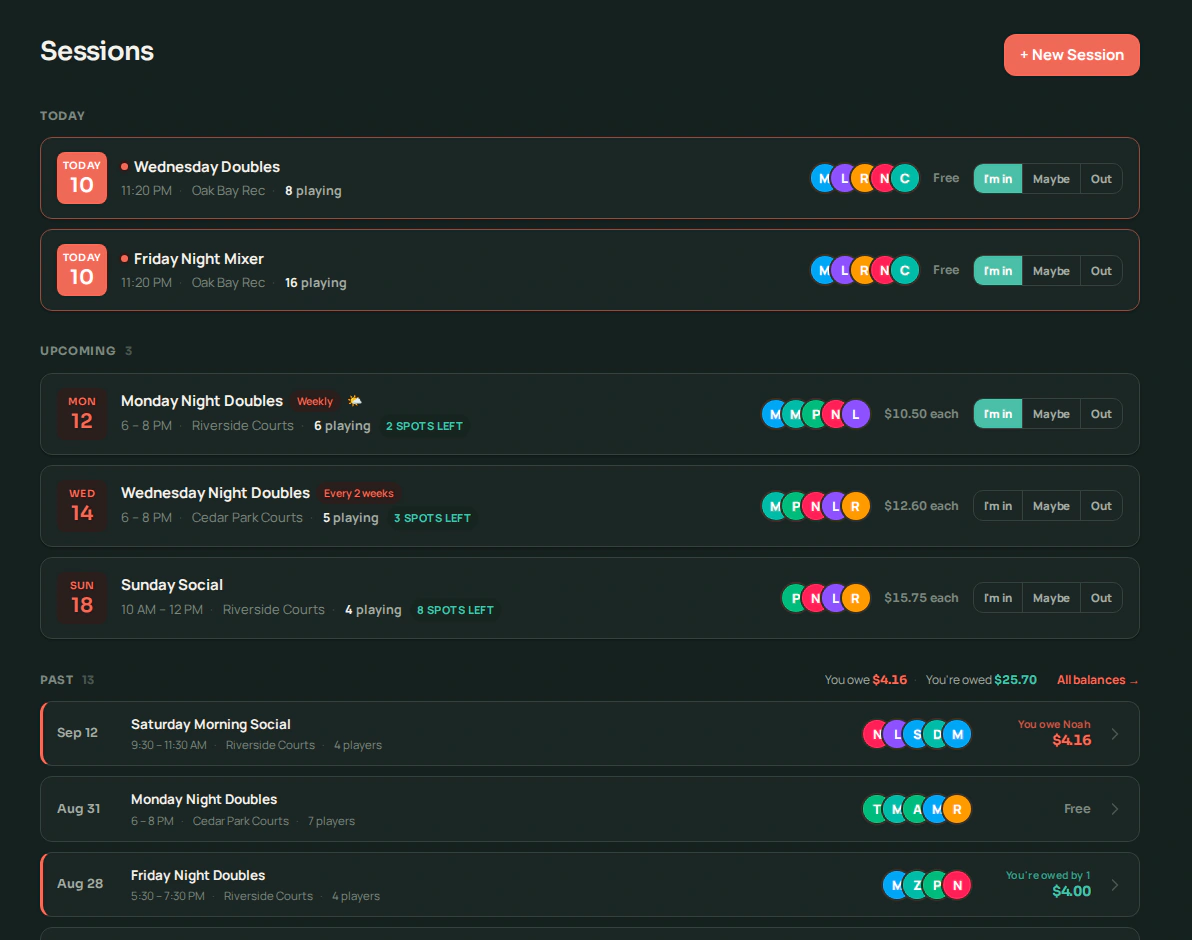
Starting a pickleball group is easy. Eight people, a court, one Saturday. Keeping it running is the part nobody warns you about, and most groups that fold do not fold because people stopped enjoying pickleball. They fold because the organizing quietly became one person’s unpaid job, and that person got tired.
This is what actually has to be decided, roughly in the order it comes up. None of it is complicated. It just has to be decided once, out loud, instead of re-negotiated every week.
Start with the slot, not the people
The instinct is to gather people first and find a time that suits everyone. That is backwards, and it is the most common reason a group never gets off the ground: there is no time that suits everyone, so the search never ends.
Pick the slot first. One weekday evening or one weekend morning, same time every week. Then invite people to that. You will lose a few who genuinely cannot make it, and you will gain a group that actually exists.
A fixed slot does something a flexible one cannot: it becomes a habit rather than a decision. Nobody has to weigh up whether to come on Tuesday, because Tuesday is pickleball. That is worth more than accommodating two extra people.
Work out how many players you actually need
Do the arithmetic before you recruit, because it determines everything that follows.
One court of doubles needs four people. Two courts need eight. Whatever that number is, you need a pool meaningfully larger than it, because real life removes two or three people from any given week.
The shape most groups settle on is a pool about half again as large as the number playing. Need eight on the floor, carry twelve to fourteen. Below that, every week is a negotiation. Much above twice what you need and people start showing up to sit and watch, which is its own reason to stop coming.
If you are past about sixteen and still on one court, you do not have a group with an attendance problem. You have two groups sharing one night.
Decide the money rule before there is any money
If your court is free, skip this. If it is not, settle it in week one, because this is the single most common source of quiet resentment in recreational groups.
The default that works: the session’s cost splits evenly across whoever actually played, and whoever booked gets paid back. Not split across whoever was invited, and not absorbed by the organizer as a favour they will come to regret.
Then settle the three awkward cases before they happen:
- Does a no-show still owe? If you paid for the court either way, someone has to cover it. Most groups say a confirmed no-show owes their share, and it is much easier to say that in advance than to invoice a friend after the fact.
- Do guests pay? Either they owe a share like anyone else, or the person who brought them covers it. Both work. Answering it differently depending on who brought whom does not.
- What happens when the fee changes? Peak slots and indoor bookings cost more. Record what each session actually cost rather than an average, or the ledger slowly stops matching reality.
The bookkeeping itself is a solved problem, and the trick is to net balances between people rather than tracking every session as its own line item. There is more on why that matters in Who Owes Who.
Stop asking who is in
Here is the habit that kills organizers: posting “who’s in Friday?” every week, then chasing replies, then doing a headcount, then doing it again seven days later.
The problem is not the message. It is that a group chat starts every week from zero. It is built for conversation, not for holding the answer to “is there a game this week and who is coming.”
What replaces it is a standing session that already exists, that people join or leave themselves, with a cutoff time after which it is on or off. The cutoff matters more than it sounds: it takes the judgement call off the organizer, so nobody has to decide whether five confirmed is enough, and nobody has to be chased. The rule decides.
How to Stop Re-Posting “Who’s In Friday?” Every Week goes into what to do about the people who never reply, and why that mostly fixes itself.
Make the games competitive, not just equal
Once the group is running reliably, the thing that determines whether people stay is whether the games are any good.
Most groups rotate partners round-robin and call it fair, because it is equal. Everyone gets the same court time. But equal playtime and a good session are different things: pair your two strongest against your two newest and the game is over by the third point, and nobody on that court enjoyed it.
What people actually mean by a fair session is that the games were close. That is a matching problem, not a scheduling one. Glance at how players are matched rather than only whose turn it is, and pair so the two sides land close in strength.
You do not need a formal system to start. You need to stop pairing purely by rotation order. Fair Doubles Rotations covers the four formats groups actually use and when each one is right.
Keep a record, but keep it small
Groups that try to track everything end up tracking nothing, because someone has to do the recording instead of playing.
The set that survives contact with a real Tuesday night is three facts: who played, who won, and against whom. Everything genuinely useful is computed from those. Ratings, streaks, who your toughest matchup is, who you have never beaten. All of it comes out of the same three fields, and all three are things people will actually write down between games.
Skip point differentials, shot statistics and attendance streaks until someone asks for them. Usually nobody does. Win Rate Is Lying to You covers why a raw win-loss record is the least useful of the numbers you could keep.
Expect the six-week dip
Almost every new group has a wobble somewhere between weeks four and eight. Novelty wears off, two regulars have holidays in the same fortnight, and one week you are short. This is normal and it is not a signal that the group is failing.
What gets you through it is that the session still exists without anyone rallying it. If the group depends on someone posting an enthusiastic message every week, the first flat week is the last week. If it is a standing thing with a cutoff, a thin week is just a thin week, and the following Tuesday is unaffected.
Two practical things help. Have a couple of people who are happy to be called in at short notice rather than committing in advance. And do not cancel out of pessimism the day before, because a session called off early can never fill up.
Hand parts of it over sooner than feels necessary
The failure mode of a healthy group is that it is entirely dependent on one person. If you organize it, you will end up booking, chasing, recording and reminding, and you will do it for months before you notice how much of your week it takes.
Split the jobs while everything is going well, not once you are already fed up. Someone else books when you cannot. Someone else records scores. Someone else keeps the roster and welcomes new people. None of these are hard, and any of them is much easier to hand over as a small standing task than as an emergency.
The measure of whether a group works is not whether it runs well while you are there. It is whether it runs at all on the Tuesday you are away.
The short version
Pick the slot first and invite people to it. Carry half again as many players as you need on the floor. Settle the money rule in week one, including no-shows and guests. Replace the weekly headcount message with a standing session and a cutoff. Match players so games are close, not just so turns are equal. Record three things and no more. Expect a dip around week six. Give parts of the job away early.
None of it is about pickleball, which is the odd part. The pickleball takes care of itself.
Related features
Keep reading
- Who Owes Who: Fixing the Worst Part of Organizing a SessionWhoever books the court also becomes the unpaid accountant. Here's why e-transfer-and-remember doesn't scale, and what actually fixes it.
- How to Stop Re-Posting 'Who's In Friday?' Every WeekGroup chats are a fine way to meet up once. They're a bad way to run a standing weekly pickleball session. Here's what actually fixes it.
- How Pickleball ELO Ratings WorkWhat an ELO rating actually measures, how the number moves after a win or a loss, why singles and doubles need separate ratings, and how ELO differs from DUPR and the 2.0 to 5.0 skill scale.
Stay in the loop
Occasional updates on new Volii features. No spam.