
Fair Doubles Rotations: More Than Just Taking Turns
Most groups solve doubles partnering the same way: rotate through everyone, make sure nobody sits out twice in a row, call it fair. It feels fair, because it’s equal. Everyone gets the same amount of court time. But equal playtime and a fair session aren’t the same thing, and the gap between them is exactly where a session stops being fun for half the players on the court.
Why round-robin breaks down
A strict rotation doesn’t know anything about skill. Pair your two strongest players against your two newest ones, and the score isn’t close by the third point. Nobody’s cheating the rotation, it’s working exactly as designed, and it’s still producing a lopsided match. Do that twice in one session and the newer players aren’t thinking about their rotation, they’re wondering if they should’ve come.
What “fair” actually means
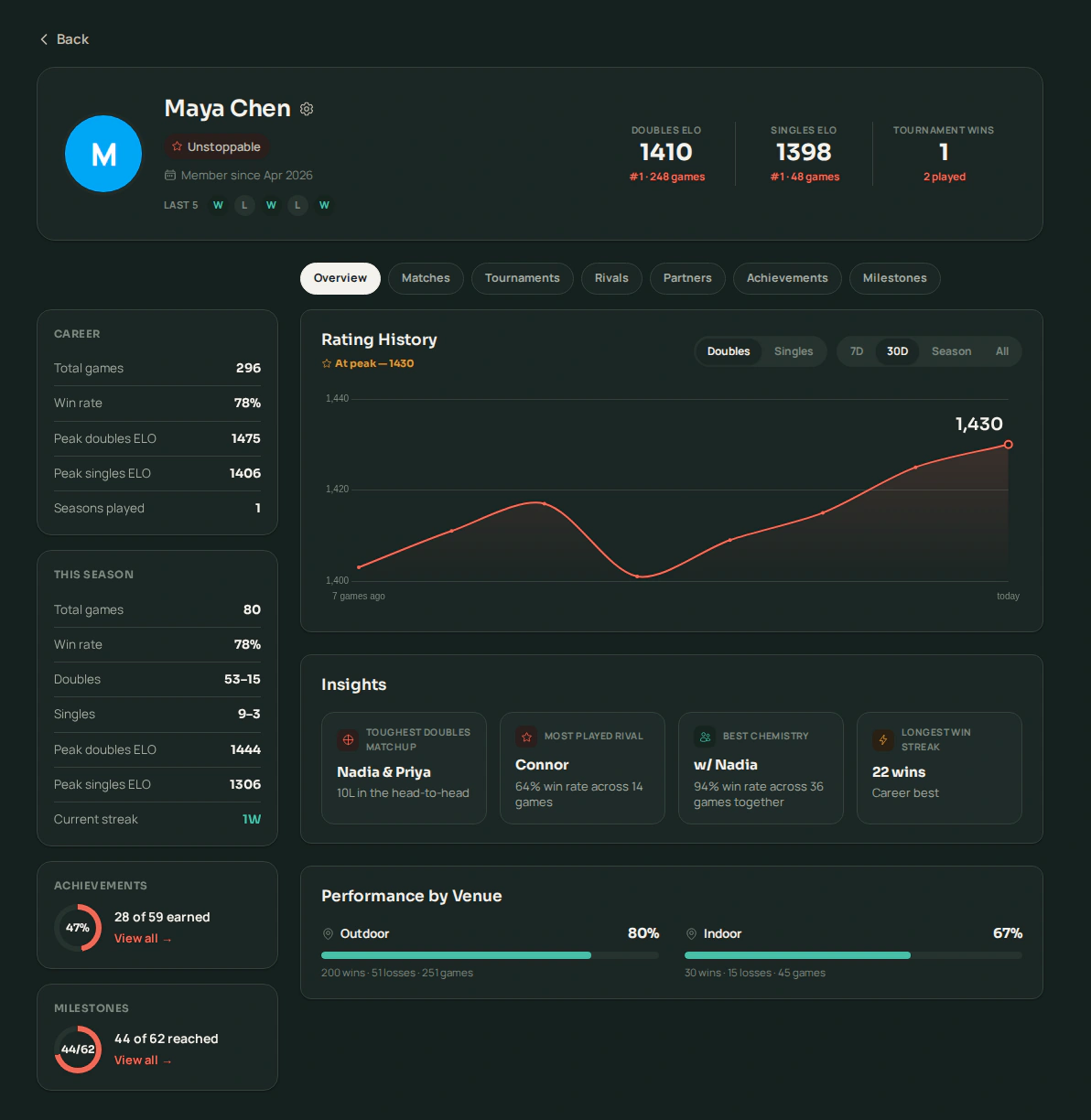
Ask someone what a fair session looks like and they rarely say “I played the same number of games as everyone else.” They say something like “the games were close” or “I got a real game out of it.” That’s a different target: not equal playtime, competitive playtime. It’s also not a new idea to organizers, it’s just usually invisible. A Volii player profile already surfaces a toughest matchup and a best chemistry partner as computed Insights, because organizers have always cared about this, they just haven’t had a number for it before.
A rotation heuristic that doesn’t need a tournament bracket
You don’t need seeding or a formal ladder to use this. The simplest version: before you rotate partners, glance at Doubles ELO instead of just who’s next in line. Pair so the two teams land close in combined rating (or in individual rating, if your club has Doubles ELO set to rank players instead of teams), not so the two strongest players happen to be free at the same time. It costs one extra look, and it turns “your turn” into “your turn, against someone it’s actually worth playing.”
Four rotation formats, and when each one is right
Most groups inherit a format from whoever organized before them and never revisit it. These are the four that actually get used, and the conditions each one suits.
Winners stay on. The winning pair holds the court, the losers rotate off. Self-organizing, needs no administration, and it is the right answer for a drop-in night where people arrive and leave at unpredictable times. It is the worst answer for a mixed-ability standing group, because it hands the most court time to the strongest players and the least to the people who most need reps.
Strict round robin. Everyone partners with everyone in turn. Genuinely fair on playtime, easy to run off a piece of paper, and the right choice for a group whose skill range is narrow. The wider the range, the more lopsided individual games get, for the reasons above.
Balanced pairing. Pair to even out combined team rating each round. Produces the closest games and the most satisfying sessions for a group with a real spread of ability. Costs the organizer a look at the numbers between rounds, and needs ratings that are roughly current to be worth anything.
Split courts by level. Two or more courts, grouped roughly by ability, with movement between them as people improve. The right answer once you are past about twelve players, because it is the only one that scales. The failure mode is social rather than competitive: courts calcify into a hierarchy nobody moves between. Move people deliberately and often enough that it stays porous.
Most groups end up wanting balanced pairing within a level-split court once they are big enough, and strict round robin before that.
Rating the newcomer without ruining three games
The practical problem with any rating-based pairing is the person who has played twice. Their number is not wrong exactly, it is just not confident yet, and treating it as gospel is how you get one blowout after another while the system works out where they belong.
Two things help. First, most rating systems, Volii’s included, move newer players faster and settle them down as games accumulate, so the number converges quickly if you let it. Second, for the first couple of sessions, put a newcomer with a strong partner against a middling pair rather than trusting the raw figure. It gives the newcomer a real game, gives the system honest data, and costs nobody an evening.
Resist the urge to hand-place people permanently. The whole point of a rating is that it updates, and an organizer’s memory of how someone played in March does not.
Spotting an imbalance before it’s a pattern
A single lopsided match is bad luck. The same two players stomping the same two players every week is a pattern, and it’s the kind of thing that’s easy to miss inside one session and obvious across a few. Doubles Partners tracks games and wins per partner pairing, with a “favorite partner” callout, and the Rivals tab ranks opponents by games played then losses, surfacing a computed “nemesis.” Look at either after a few weeks, not after one night, and the imbalance an organizer would otherwise only catch anecdotally shows up as a number.
The actual fix
Fair rotations aren’t a scheduling problem, they’re a matching problem wearing a scheduling problem’s clothes. Taking turns guarantees everyone plays. It doesn’t guarantee anyone has a good game. Look at who’s actually being paired against who, not just who’s up next, and “fair” starts meaning what people actually wanted it to mean in the first place.
Keep reading
- How to Organize a Recurring Pickleball GroupA practical guide to starting a weekly pickleball group and keeping it running: how many players you need, picking a slot, splitting court costs, keeping games competitive, and what to stop doing in the group chat.
- Who Owes Who: Fixing the Worst Part of Organizing a SessionWhoever books the court also becomes the unpaid accountant. Here's why e-transfer-and-remember doesn't scale, and what actually fixes it.
- Win Rate Is Lying to You: Tracking Stats That Actually MatterRaw win percentage doesn't know who you played. Here's why ELO, singles/doubles splits, and season resets tell you more than a win-loss record ever will.
Stay in the loop
Occasional updates on new Volii features. No spam.