
Who Owes Who: Fixing the Worst Part of Organizing a Session
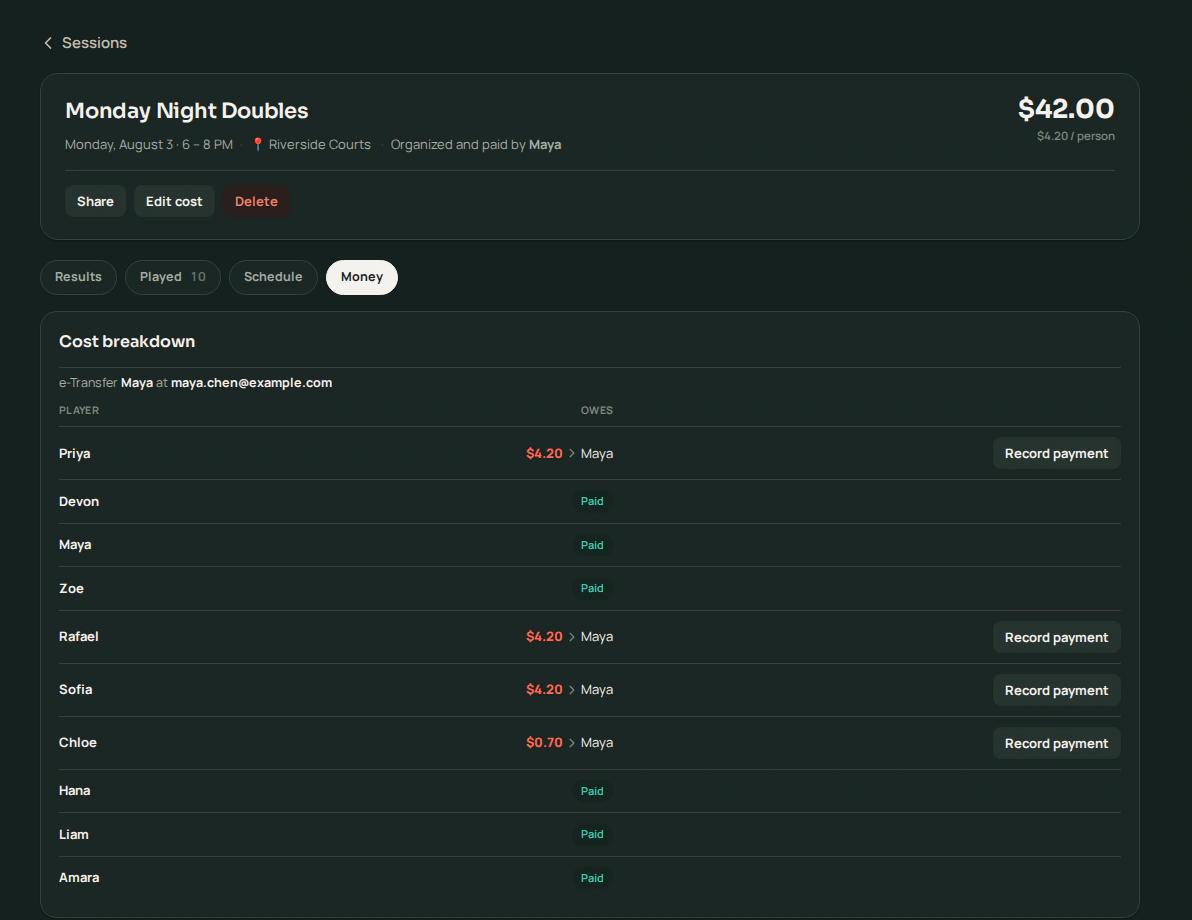
Someone has to book the court. That part’s easy. What’s not easy is what happens after: the court costs money, ten people played, and now someone has to work out who owes what, send the e-transfer requests, and remember who actually paid. Book the court often enough and you’ve accidentally become the group’s unpaid accountant.
The organizer tax
This job isn’t hard because the math is hard, splitting a court fee evenly across whoever showed up is one division problem. It’s hard because it never stops. Every session is a new round of the same math, the same reminders, and the same mental list of who still owes you from two weeks ago. None of that shows up when you agreed to book a court. It just comes with the job.
Why e-transfer-and-remember stops working
For one session, “just e-transfer me” is fine. The trouble starts once it’s a standing thing. Debts pile up across weeks, and nobody, including the organizer, reliably remembers what’s settled and what isn’t. Did Sam pay for the 12th, or was that the 19th? Multiply that by ten players and a few months of sessions and you’ve got a debt list that only exists in someone’s memory, which means it’s really a debt list that doesn’t exist at all.
What actually fixes it: net it, don’t list it
A session’s cost splits evenly across whoever played, that part doesn’t change. What changes is what happens next: instead of tracking each session’s split as its own separate line item, Balances nets every outstanding share against every recorded payment between the same two people, across every session they’ve shared. If Alex owes Sam $12 from one session and Sam owes Alex $8 from another, that’s not two contradictory numbers to keep straight, it’s one clean “Alex owes Sam $4.” Three different Tuesdays become one number instead of three.
A worked example
Say your group books the same indoor court three Tuesdays running, at $63 a session.
Week one, ten people play. That’s $6.30 each, and Alex booked it, so nine people owe Alex $6.30. Week two, only six show up, so the same $63 splits six ways at $10.50 each, and this time Sam booked it. Week three you’re back to ten, Alex books again.
Track that as a list and you have twenty-five separate line items after three weeks, most of them for less than the price of a coffee. Nobody is going to send twenty-five e-transfers, so what actually happens is that people pay in lumps, roughly, when they remember, and the list stops matching reality almost immediately.
Netted, the same three weeks collapse to one number per pair of people. Alex and Sam both organized, so most of what they owe each other cancels out, and whatever is left is a single figure either can settle in one transfer. Everyone else has one number for Alex and one for Sam, not six.
The arithmetic is identical. What changed is how many things a person has to keep in their head, and that was always the actual cost.
The edge cases that actually come up
Netting solves the bookkeeping. It does not decide your group’s policy, and these are the questions that will come up in the first month whatever software you use. Worth settling them out loud before they turn into resentment:
Someone plays half the session. Most groups don’t prorate, because the fee is for the court, not per game, and half-splitting one person’s share pushes the difference onto everyone else. Pick one rule and say it once.
Someone brings a guest. Decide whether the guest is a player who owes a share, or the host’s responsibility. Both are defensible. What causes trouble is when it’s answered differently depending on who brought whom.
The fee isn’t the same every week. Indoor and outdoor rates differ, peak evening slots cost more, and some venues charge per person rather than per court. Record what the session actually cost rather than a standing average, or the ledger slowly drifts away from what was really paid.
Someone leaves the group owing money. This is the one that damages friendships, and no ledger fixes it. What a ledger does is make the number small and unambiguous while the person is still around, instead of letting it accumulate quietly until it is large enough to be awkward.
Someone always forgets. A visible balance does most of the work here. The number is simply there next to their name, so nobody has to be the one who brings it up, which is usually the real reason these debts go uncollected.
What Volii deliberately doesn’t do
This is a trust point worth being precise about, not a limitation to gloss over: Volii doesn’t process, hold, or move any money. No payment happens through the app. Players can list an e-transfer email so a debt shows exactly where to send it, but the actual transfer, whatever form it takes, happens entirely outside the app, the same way it always has. Balances is a ledger and a reminder system, not a payment processor, and it’s built that way on purpose.
The actual fix
The goal was never to automate payment, court fees are simple enough that automating the transfer wouldn’t save much. The real cost was always the mental math: remembering who owes what, across how many sessions, and whether it’s already been settled. Net it automatically and that mental math disappears, the transfer itself was never the hard part.
Related features
Keep reading
- How to Organize a Recurring Pickleball GroupA practical guide to starting a weekly pickleball group and keeping it running: how many players you need, picking a slot, splitting court costs, keeping games competitive, and what to stop doing in the group chat.
- Fair Doubles Rotations: More Than Just Taking TurnsRound-robin partner rotation feels fair. It isn't, once skill gaps enter the picture. Here's what to optimize for instead.
- How to Stop Re-Posting 'Who's In Friday?' Every WeekGroup chats are a fine way to meet up once. They're a bad way to run a standing weekly pickleball session. Here's what actually fixes it.
Stay in the loop
Occasional updates on new Volii features. No spam.